
Lara Croft made the discipline popular when she stole her first artefact in the puzzle solving game Tomb Raider in 1993, and it seems archaeology retains that pulling power to attract players. After Tomb Raider sprung to the public’s imaginations, other similar characters such as Nathan Drake in Uncharted and Aliya Elasra in Heaven’s Vault have proved equally as popular. Since the release of Tomb Raider, video games have come along way, no more are the awkward blocks and 2D backdrops. In 2018 the environment of ancient Greece was designed for Assassin’s Creed Odyssey, it proved so authentic that a non-combat Discovery Tour version was released in 2019, allowing players to explore an almost historically accurate and thriving Acropolis all without the need to steal an artefact to unlock an achievement.
Video games have done such an astounding PR job for the profession with mainstream games such as Uncharted and Tomb Raider that they have inspired players to put down their controllers and pick up a trowel instead. Archaeology in reality, pales to the fantasy adventures of Lara Croft or Indiana Jones. But can we utilize the world building element of video games to engage with the public? The part of the human story that could benefit with such PR is the early prehistory (Palaeolithic- Neolithic or commonly known as the “stone age”), which almost never appears in the narrative of mainstream video games.
The designed worlds in video games are so intrinsic and real to the player that they make very engaging and effective public engagement tools. The fragmented nature of the archaeological record denies the full picture being seen, but video games, implementing the landscapes in historically accurate environments provide an insight to how this fragmented evidence could look in reality. Historical stimulation using the archaeological record may not appeal to the academic within us, seeming a bit gimmicky and altruistic, but they could unleash a new generation of archaeologists. However, prehistoric landscapes rely on preserved organic/palaeoenironmental remains in order for us to understand them, without the written record, archaeology is all we have, and how can soil and seeds recreate a landscape in the imagination of a child?
It has been done before and quite conveniently through the mechanics of Minecraft. The archaeology feature implements structures into the game called archaeology sites. This structure has blocks disguised as normal ones that have hidden treasures hidden inside of them. Users have also recreated real life archaeological prehistoric sites such as the Bryn Celli Ddu henge and burial tomb. Manchester Metropolitan University student Ben Edwards used his extra time at home to tackle an ambitious virtual building project. Rebuilding the monument in “Minecraft” lent Edwards “the freedom to reconstruct the landscape as it would have looked in the Neolithic [era],” he tells British Archaeological Jobs and Resources’ (BAJR) online news service, “right down to accurate hills, trees and rivers—something we had never done before.”
Archaeology can be an unobtainable world, the artefacts and structures buried in the dirt can struggle to spark the imagination of the public especially when those artefacts come from an era way before the adoption of farming and settled communities. Games focus on well-crafted environments that provide focal points of interest for players. This can easily make a game uniform and monotonous if not designed effectively.
Prehistory is not completely understood, the fragmentary nature of the archaeological record makes it hard for the record to be interpreted. However, that does not mean it cannot be implemented fully. The public may understand the context of a roman mosaic floor, but that understanding is usually understood within the context of standing archaeological sites such as Pompeii or Rome. The landscape and how our hunter gatherer/tribal ancestors interacted and understood it, is less understood even by the most experienced prehistorians.
An influx of interested academics in the esoteric subject of Archaeogaming means this is becoming a less taboo subject left in the margins of a few interested individuals. Although the literature is bogged down by the usual suspects of the previously mentioned Assassin’s Creed and Tomb Raider. The prehistory has had somewhat of a look in with Far Cry Primal and Dawn of Man releases. Dawn of Man is supposed to take place in the Palaeolithic period, an area of archaeological research in the UK which is scarce of substantial finds. The game is world building but primarily focuses on developing a settlement, while this game is engaging for prehistorians or keen hobbyists it fails to properly reconstruct a prehistoric landscape. For the purposes of public engagement it would be impractical.
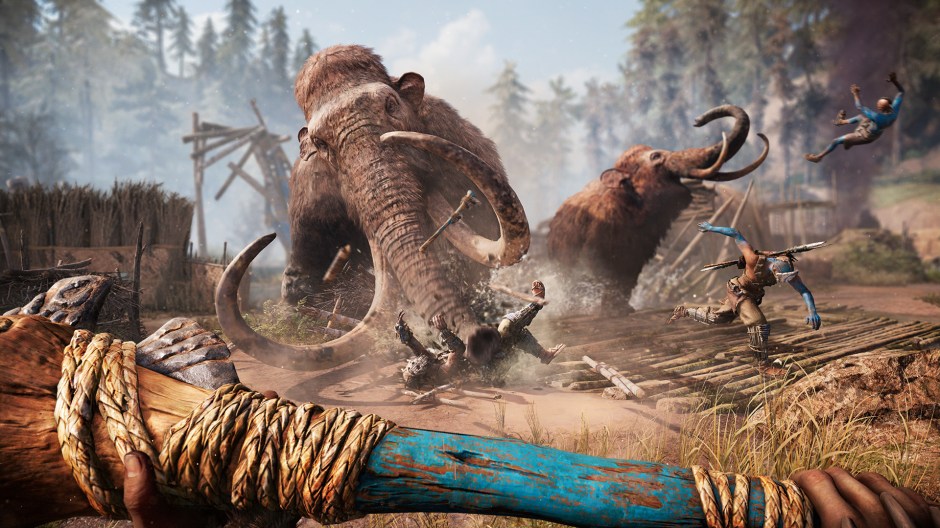
The mainstream third person games is the way forward for a truly immersive experience, Far Cry Primal was the closest we got to this. Set in Mesolithic Central Europe. It provided a number of tropes that unfortunately distract from the complex game environments that the developers have created. Tropes such as the presence of the sabre-toothed cats, which became extinct n Europe in 26,000 BC meaning that their presence in a Mesolithic Europe at around 10,000 BC means it’s highly unlikely that they would be roaming around the landscape as they are depicted in the game. While there is nothing wrong with providing a landscape that creates the feeling of a Stone Age landscape. The perpetuation of these tropes in the media make it hard for those outside the archaeological sphere to truly appreciate how humans evolved and progressed. The Stone Age (Palaeolithic, Mesolithic and Neolithic) periods do not appear in the mainstream media often, is it because archaeologists have failed to spark the imaginations of the general public? Or is the lack of data, and the apprehension to interpret such data a contribution to the greater public understanding of these highly misunderstood periods.
The issue with prehistory is that it expands such as a long period of time that it can be homogenised and be melded into something that does represent the different time periods. But built-in engagement doesn’t necessarily need to rely on archaeological/historical accuracy to become a useful tool in public meetings. However, it does need to have some resemblance of the truth I order to create honest discussion. Another game that although fantastical in almost every element had some truly inspiring landscapes is Hellblade: Senua’s Sacrifice. The game was developed by Ninja Theory and released in 2017, and focuses on mental illness and episodes of violent psychosis. It follows a Pict woman who has psychosis and goes to the underworld in order to save her dead lover’s soul. Although it is not set within prehistory, it is set in a period of history frequently referred to as the Dark Ages due to the scarcity of records. There seems to be something rather authentic about the artefacts assemblages scattered throughout the game. We learn about the ideological concepts through the iconography, statues and landscapes. This faithful interpretation likely owed to Dr Elizabeth Rowe of the University of Cambridge, an expert in Scandinavian History in the Department of Anglo-Saxon, Norse and Celtic, who helped to develop the narrative of the game.
Contrary to what we know about the Early Medieval period like that represented in Hellblade, the nuance of trade, communication, and ideology means that the prehistory can be daunting for videogame creators, hence when a prehistoric backdrop is utilized in popular games it tends to be highly conceptual or completely inaccurate with games set in the prehistoric Age committing the predictable mistake of placing our ancestors in a world full of dinosaurs (Raso, 2011). Aside from this vision of prehistory full of interpretive mistakes, however game mechanics become very useful when translating the precarious nature of stone age life. For example, as Raso states (2011, p.85) “the survival of the individual and his social group or band was closely related to the nutritional resources they could obtain, an omnipresent aspect in the monographs concerning the most classic prehistoric sites.”
This is characterised in Horizon Zero Dawn when hunting the robotic creatures that dwell in a dystopian landscape. Its Neo-prehistoric world allows the developers to hypothesize how humans would react to the environment full of pseudo mega-fauna. Due to the sci-if aspect of its premise Horizon Zero Dawn overcomes the limitations of a prehistoric setting. The landscapes become a place for the player to explore and evaluate in an archaeological context where the debris piles serve as an artifact assemblage to be analysed. The game takes place in a world with gatherer-hunter communities have since developed in the time after an apocalyptic event complete with their own ideology, politics, and trade. As Reinhard (2017) states “artefacts and landscapes post-modern and culturally relativistic interpretation.”
There is game that tries to recreate the dangers and of a prehistoric landscape. Released in 2019 for Microsoft Windows, PlayStation 4, and Xbox One, Ancestors: A Humankind Odyssey was developed by Montreal-based Panache Digital Games. A single-player, set 10 million years ago third-person adventure game set in a generic African landscape (consisting of ecosystems such as tropical rainforest, savanna, and coastline). The main goal of the game is survival, the player’s progress can easily be lost if the members of their clan die, players learn how to survive by a trial-and-error approach to the various social interactions, cross-species encounters, and tool use opportunities that are available in the game environment. A similar concept was created by Rubio Xavi for educational purposes. Ancestors: Stories of Atapuerca‘s game mechanics were based on the everyday activities of the hunter-gatherer lifestyle: hunt, make tools, gather resources, move camp etc (Rubio-Campillo 2020; p.53). The game also included small details which are often invisible in videogames such as the presence of children and the elderly.
There are many ways for this to become a reality but involves the archaeological community, the commercial and academic sectors working together to create something that is entertaining, immersive, realistic but also fun to play. The key is to create a connection to the player, and this doesn’t necessarily need to be done through the game mechanics, but through the narrative or characters. It doesn’t necessarily have to be accurate either as shown in Hellblade and Horizon Dawn Zero, but it does need to be represent the past in a way that feels authentic.
The human story started when our ancestors were hunter-gatherers, and this part of our narrative tends to be the pushed to the margins, maybe it reminds of a time when we were truly vulnerable, or the lack of written history makes its more of a dark age. Whatever the barriers, it is up to the academics and media to show how interesting and stimulating this period of human story can be.
- Snyder, W.D., 2022. Have Video Games Evolved Enough to Teach Human Origins?: A Review of Ancestors: The Humankind Odyssey. Advances in Archaeological Practice, 10(1), pp.122-127.
- Raso, D.G., 2016. Watching video games. Playing with Archaeology and Prehistory. AP: Online Journal in Public Archaeology, 1(2), pp.73-92.
- Rubio-Campillo, X., 2020. Gameplay as Learning: The Use of Game Design to Explain Human Evolution. Communicating the Past, p.45.
 Archaeoblog