
This article has been written and published for Real Archaeology, an online event where a number of creators are producing archaeology-related content on various platforms.
Like with any game inspired by Dungeons and Dragons, one cannot help but reminisce on the past. As our ancestors worshipped, the skies and the earth, the druids of Baldur’s Gate 3 are no different. The inspiration taken from the Iron Age people of Europe plays a large part in game media, but it’s not all fantasy. Even in medieval fantasy roleplaying games, they can seem like a magical gateway into the past.
Obviously, there are no mind flayers or walking undead in our history. But video games allow an appreciation of the past that some may not appreciate by standing on an Iron Age hillfort, or walking within a stone circle like Avebury. Every culture in the past had its own version of a cleric, fighter, sorcerer or wizard. However, druids are a specific nod to ancient Celtic figures who played a role of great importance within their communities. The Iron Age druids were more like institutions that we would recognise in a present day context, such as religion or political parties.
Tracking the archaeological footprint of the druids is a difficult task. The druids have been known for at least 2400 years, first by Greek writers and later by the Romans, who came in contact with them in Gaul and Britain. According to Roman sources, druids were a learned caste who oversaw religious ceremonies, taught the ancient wisdoms, and were known in their communities as philosophers and learned counsel. Although these writings may not always have been completely accurate, or indeed truthful, it does seem clear that the druids were an important group of people in many Iron Age societies.
While it could be argued that the druids featured in Dungeons and Dragons are far removed from reality, there is some similarity when comparing them to their real life counterparts. Druid character classes were first introduced in early D&D supplements before being codified in the 1st edition Player’s Handbook of Advanced Dungeons & Dragons.
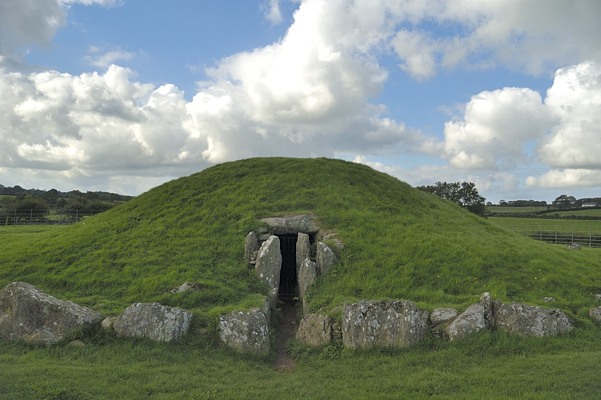
There is limited written record, and the material culture comes in many forms such as sacred spaces, art, ritual equipment, images of the gods, strange burial rites and to some extent “human sacrifice”. Evidently archaeology tells a different and more complicated story of this enigmatic priesthood, a theocracy with immense political and sacred power. One of the main druid archaeological site overlooks the Irish Sea from the northwest corner of Wales, Anglesey is dotted with numerous Neolithic and Bronze Age stone monuments. The most famous is the 5,000-year-old passage tomb of Bryn Celli Ddu (Welsh for “the mound in the dark grove”), which has an entrance passage that aligns with the rising midsummer sun. It was archaeologically excavated in 1928 and 1929, and later reconstructed some time in 1930s.
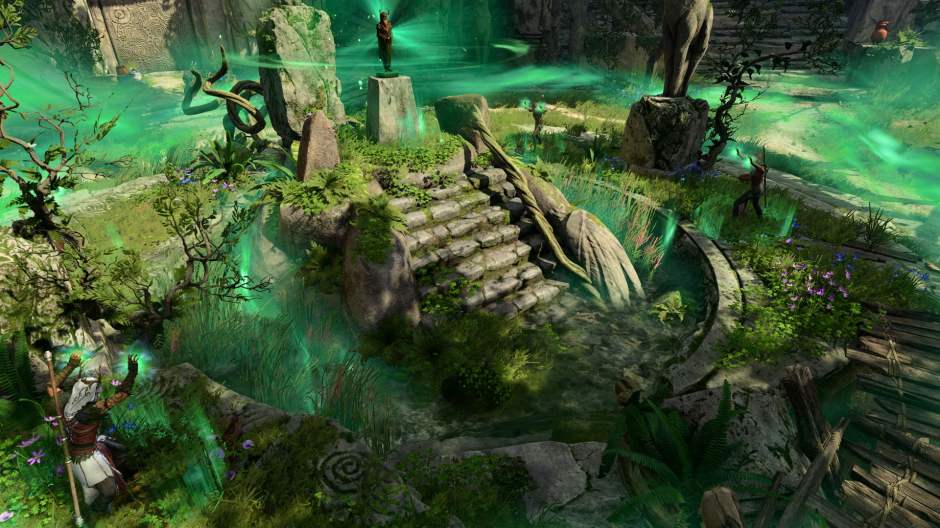
Interestingly, in Baldur’s Gate 3 and Dungeons and Dragon lore as a whole, the areas within the world of Faerun inhabited by the druids are usually groves. In Baldur’s Gate 3, the druids are located at the Emerald Grove close to the coast. The Emerald Grove, much like its real life comparison has interesting circular design. Stone Circles are prevalent in the British Isles, and they have been interpreted as a passage to the afterlife.
The Emerald Grove reflects an architectural sign of both moral and spiritual simplicity when compared to more elaborate places of worship in the game, such as Rosymorn Monastery close to Mountain Pass and the Temple of Shar close to Reithwin Town. This is more relevant for the druids, who reject the ornate and consider nature as their temple. This is nicely summed up by the main druid in the party, Halsin who states
“The city you mean? With all its noise, smoke, stone and bustle? I would not be here given the choice, but I have promised you my support. And that is what you shall have. This place crawls with life, but little of it flourishes. I see refugees unhouse. The destitute unwanted. Orphans unloved. The city is like a forest with an overgrown canopy. Light and nourishment can be penetrate it to those who need it the most… and still it draws them in. The safety in numbers. The promise of civilisation. The dream of better. All that potential is destined to die in the dark, and rot in the gutter. I wish for there was a better way,. I wish everyone could see the sun, have a full belly and see nature as a friend.”
Fekzak (2023: 294 ) states “there is no coincidence that the temple ruins oftentimes remain outside the scope of the in-game civilization; one can hardly find examples of abandoned(and haunted, or taken over)buildings and sacred sites within the city space, as if the architectural and metaphysical signifiers of religion gradually lose their meaning along with their proximity to the in-game cultural hubs.”
In terms of ideology, the main deity for the druids in Baldur’s Gate 3 is Silvanus, who is based on the Silvanus from Roman ideology, the god of the countryside, similar in character to Faunus, the god of animals, with whom he is often identified; he is usually depicted in the guise of a countryman. It is cognate with the Latin words silvester (‘wild, not cultivated’), silvicola (‘inhabiting woodlands’) or silvaticus (‘of woodlands or scrub’). The etymology of silva is unclear. Silvanus as a deity was mainly concerned were with nature itself, and more especially with “wild nature in all its raw beauty and violent brutality” (Shideed 2024: 211) Silvanus appears to be have been a popular god with the druids of Britain, who’s Celtic equivalent was known as Sucellus and Dagha. It is likely Silvanus was assimilated into the own pantheon during the Roman conquest, allowing for a continued worship of the original god Sucellus.
The interplay between civilisation and barbarism is felt throughout the game’s narrative, and is comparable to the Roman invasion of Britain known then as “Albion”. The Romans believed they intelligence and sophistication, but quietly feared their aggression and valour in the battlefield and their “barbaric” rituals. Consequently, the Romans and Greeks depicted the druids as bogeymen, spiritual medium that could channel the dark arts. It is more than certain that these records are biased, wartime propaganda on a people they believed to be inferior. Similarly to the conquest of Mexico, where the Mexica Empire was seen as barbaric with a leaning towards devil worship by the Spanish conquistadors.
The archaeological evidence is quite fragmentary when it comes to their ancient practices. However, historical records, such as Julius Caeser’s description when he confronted them during his attempt at conquest, may give us an insight to see how they viewed by a more “civilised” culture.
The whole nation of the Gauls is greatly devoted to ritual observances, and for that reason those who are smitten with the more grievous maladies and who are engaged in the perils of battle either sacrifice human victims or vow to do so, employing the Druids as ministers for such sacrifices. They believe, in effect, that, unless for a man’s life a man’s life be paid, the majesty of the immortal gods may not be appeased; and in public, as in private, life they observe an ordinance of sacrifices of the same kind. Others use figures of immense size, whose limbs, woven out of twigs, they fill with living men and set on fire, and the men perish in a sheet of flame. They believe that the execution of those who have been caught in the act of theft or robbery or some crime is more pleasing to the immortal gods; but when the supply of such fails they resort to the execution even of the innocent.
– Julius Caesar, Commentaries on the Gallic War, VI 16
In Baldur’s Gate 3, there a many are classes and cults that can be compared to devil worship, the Cult of Bhaal, worships murder and chaos. The druids depicted in Baldurs Gate 3 are multifaceted, some times they seem like a barbaric priesthood, perpetrating savage and blood rites ancient Britain and Gaul in the name of their gods as described by the Romans 2,000 years ago. The main druids featured in Baldur’s Gate 3 are Halsin and Kagha, one follows the nature loving stereotypes represented in the media. Kagha is represented by the barbarism of the druids when confronted by outsiders. In Iron Age Britain, Tacitus wrote with revulsion of the dark groves on Anglesey, haunted by Druids and containing crude and sinister altars soaked with the blood of human sacrificial victims. It is later revealed (if you choose to investigate) that Kagha is being controlled by the Shadow Druids, a druidic cult which believes that nature should drive out civilization with violence.
In Baldur’s Gate 3, the druids are a warrior class, where spells and feats aid them and their party during combat encounters. They take an active role in the battlefield by shapeshifting into animals, and using nature-based spells to take down enemies. Obviously, the role of a druid in the Dungeons & Dragons lore allow the player to participate in battles, which is a key element in the table-top game and Baldur’s Gate 3. Real druids played a more advisory role, however, there were exceptions such as Anglesey’s Druids who faced the Romans in 60 CE. Ancient Roman historian, Tacitus, wrote a detailed account about a major battle between the inhabitants of Anglesey and the Roman army in 60 CE, led by General Suetonius Paulinus (Tamblyn 1909).
It is unlikely that the true nature of the druids will ever be understood, archaeological evidence is too fragmentary and history records are biased and must be treated with caution. Despite this, the enigmatic nature of the druids has captured the imaginations of modern audiences, they appear in movies, games, books, and have even inspired a modern day religious movement in the form of neo-druidism, which focuses on the divine essence of nature. Neo druids follow a more medieval romanticism depiction, animal loving following wise leaders, and respecting the balance of nature. Arising from the 18th century Romanticist movement in Britain, which glorified the ancient Celtic peoples of the Iron Age, the early neo-Druids aimed to imitate the Iron Age priests who were also known as druids.
The media, modern and historical druids all maintain a relation to nature. Baldurs Gate 3 is no different. The controller allows players to engage with a past that is shrouded in ambiguity. An art form where antiquity can transform, and be consumed and interpreted by the present.
- Felczak, M., 2023. Sacred Places and Spatial Design in Fantasy-themed Isometric cRPGs. Culture & Theory Volume 262, p.287.
- Tamblyn, W.F., 1909. British Druidism and the Roman War Policy. The American Historical Review, 15(1), pp.21-36.
- Shideed, R.M., 2024. Silvanus the Neglected god. Journal of Association of Arab Universities for Tourism and Hospitality, 26(1), pp.205-213.
- Waddell, J., 2023. Rethinking the Ancient Druids. An Archaeological Perspective: By Miranda Aldhouse-Green. Cardiff: University of Wales Press, 2021. 188 pp. Illus.£ 45.00 (pbk). ISBN 978-1-78683-797-4. Also available as an e-book.
 Archaeoblog